The Persistence of Identity
What survives when everything changes
How Organizations, Cultures, and People Survive Change
A Meditation on What Endures
Marc Lamalle
Read the Preview ↓The Persistence of Identity in one view
A visual map of the argument.
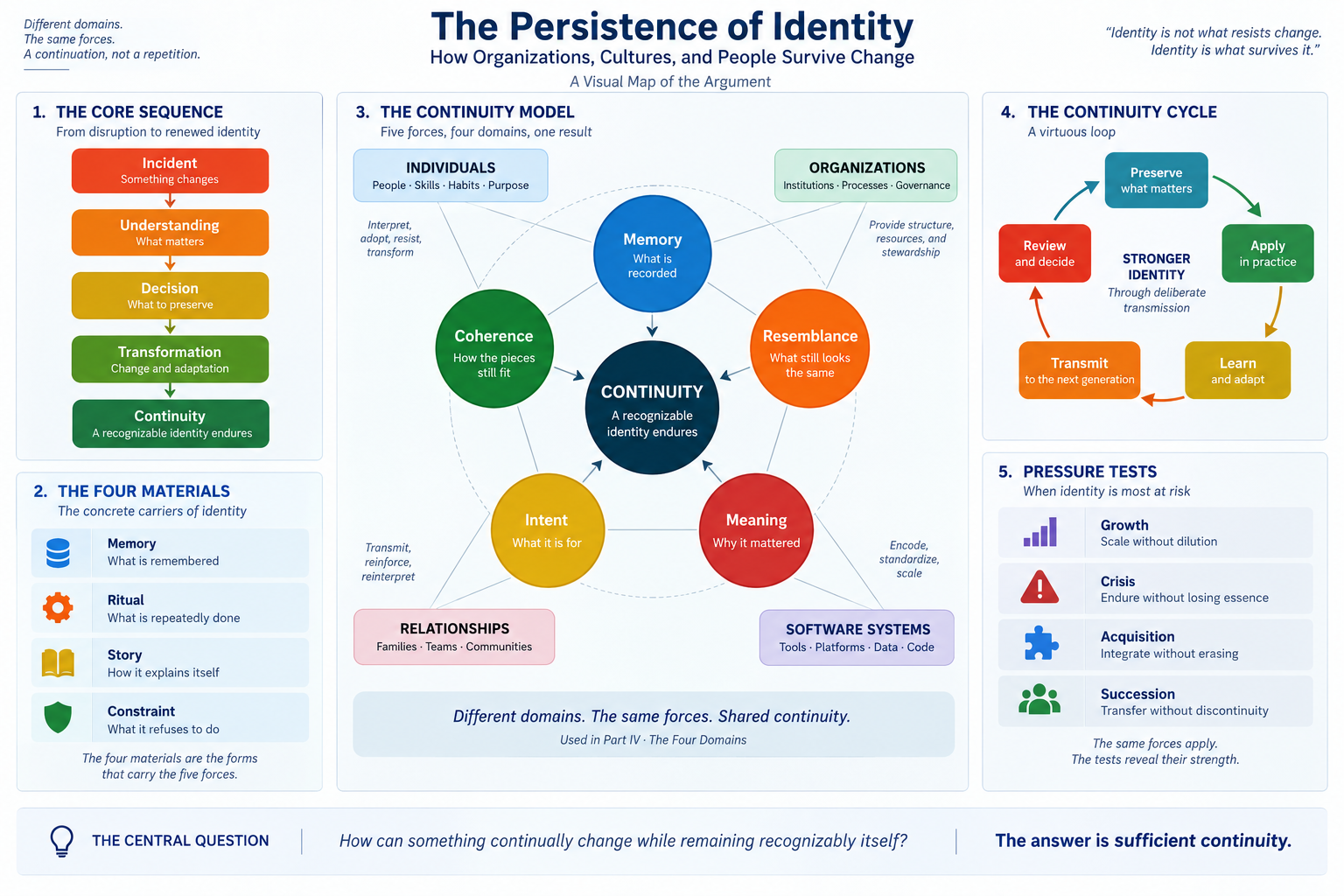
Identity is not preserved by refusing change; it is carried through change by five forces operating through four concrete materials.
If every part is replaced, what remains? This book answers with a working model of continuity rather than a metaphor. Identity is not preserved by refusing change; it is carried through change by five forces — memory, resemblance, meaning, intent and coherence — operating through four concrete materials: memory, ritual, story and constraint.
Five forces of continuity: memory, resemblance, meaning, intent, coherence, and what is lost when each is removed.
Four materials: the concrete carriers through which the forces operate — memory, ritual, story, constraint.
Four domains: organizations, software systems, relationships, individuals — the same diagram, four substrates.
The continuity cycle: inherit, decide what matters, preserve enough, transmit deliberately, be recognized, and be inherited again.
Four pressure tests: growth dilutes, crisis distorts, acquisition absorbs, succession forgets. Six claims, each anchored in institutions that illustrate them.
Identity is not what resists change. Identity is what survives it.
- Length: 31 pages
- Language: English
- Series: standalone (companion to the Foundational Trilogy)
- Imprint: NexoraGlobal
Institutions cited in the book — the BBC, the Federal Reserve's FOMC, NASA, the Benedictine Rule, Notre-Dame, Linux, Unix, TeX, SQLite, Berkshire Hathaway, LVMH, the NTSB — are used as illustrations of the claims, not as empirical proof of the general theory. Causal wording has been deliberately avoided throughout.
Read the Preview
A partial preview of the English manuscript: opening pages 2–10, followed by the complete “The Four Pressure Tests” passage on page 28. This is not the complete book.
English manuscript · page 2 / 31
Inside cover
Identity is not what resists change. Identity is what survives it.
This book is a meditation on continuity - on why some organizations, cultures, and people remain recognizably themselves across decades of upheaval, while others dissolve after a single reorganization.
It is not a management book. It is not a philosophy book. It sits between the two, in the territory where leaders actually live.
Read it slowly. It is meant to be returned to.